

By Tyler Sheedy
Imagine you are 40 miles into a race. It’s the longest you’ve ever run, and everything has gone wrong. Just an hour ago, you were running like the wind. Now, each step is excruciating. The dreams you had of winning the race are just ten minutes up the road, but there’s nothing you can do to catch them and you know it. You look down at your watch. Only 60 miles to go.

Growing up in the Sheedy household, a 100 mile race never sounded all that far to me. Whether it was the fact that both my parents are ultramarathoners and many of their friends have run that distance, or perhaps all the documentaries we’d watch where professional athletes made it look so easy, I have wanted to run a race of that length as long as I can remember. Even when I was in high school running races no longer than a 5K, it was normalized in my life to the point where finishing my first 100 miler was always a matter of when, not if. And more than anything, the question was “how fast?”
Looking towards the summer after my final semester of college, the timing seemed right. I was no longer racing track competitively, had shown potential in shorter ultras, and I was about to move to Colorado to start my new life a few months after graduation. Originally, I planned to spend my summer hiking the famous Appalachian Trail, but logistically it didn’t make sense. Knowing I would have many years to thru-hike later in life and less time now to reach my potential as a runner, I realized the Vermont 100 Miler on July 18th was the perfect opportunity to make my debut, one week before moving west. Plus, I would have one last summer at home to spend time with my family and train up in the White Mountains. In late November I took the leap of faith, and signed myself up.

For many Vermont 100 hopefuls, there is a long wait list and a limited number of spots. However, following in the footsteps of my dad, I elected to fundraise for Vermont Adaptive and guarantee myself a spot on the line. Vermont Adaptive is a wonderful organization that provides opportunities in sports to people with disabilities, most notably in skiing. Fundraising helped cover the cost of lessons, modified equipment, and a variety of other hurdles. Altogether I raised more than $4000, which not only was enough to earn my bib, but also made an impact in making sports more accessible for everyone. Many times during training, I thought about not only the friends and family who donated on my behalf, but also how lucky I was to have the ability to take on the challenge of a 100 mile race.
From the beginning, there was only one goal: win the race. It might sound crazy, considering there were so many unknowns. With this being my first 100 miler, I didn’t know how fast I could run, or how my body would react after that many hours of moving. I had no idea who my competition would be, or even how I might prepare myself. But there were a few things that I did know. First off, in the ultra world, I am fast. Compared to the NCAA, I was not – but in ultramarathons, there aren’t many people who can break 15 in the 5K. Second, I had no idea what my potential in ultras might be, which made me feel dangerous. While I’d likely reached my ceiling on the track, I have always preferred running longer distances and felt like that’s where I can truly excel. And finally, I can climb as well as anybody. I placed 12th at the USA Mountain Running Championships in my first mountain race ever, and have spent many summers up in the White Mountains climbing peaks to my heart’s content. So while my experience was lacking, I felt like I had a great foundation and was super excited to get to work.

The primary goal of training in the spring was to get my body accustomed to being out there for a long time. I knew I didn’t need any speed, so I just would head off into the woods and have fun exploring as far as I wanted. On weekends I would do 20+ mile long runs back home in New Hampshire, and sometimes would show up at my 8am classes having already logged 16 trail miles on a loop near my house in Rhode Island. I was running 100 miles a week for the first time in my life, and by the time school ended it was time for my first fitness test of the summer.
The Big A 50K is an awesome race at the beginning of May on Mt Agamenticus, about a 20 minute drive from Dover. My goal going into the race was to attack Patrick Caron’s record of 4 hours, 48 minutes. My PR in the 50K was a 3:41 from the fall, but the trails on Mt A were far more technical and Patrick is one of the best trail runners in New England, so I knew it would be a fight. The plan was to try to match Patrick’s splits on the three-loop race of 1:30, 1:36, 1:42.
The whole way, I thought something would go wrong and somehow the course would get harder, but I got out just how I wanted and maintained that speed the whole time. The splits were 1:30, 1:28, 1:29 and I ran 4:27 to smash the course record. Looking at the data, I was extremely pleased with the result, especially because I had taken a wrong turn early on and added on a full mile. It was a big win, and for better or for worse, I had made a name for myself in the New England trail scene. After a few days off, I was pumped and ready to get back to the mountains and see how fit I could get.

Over the next few months, my volume remained high as I spent a lot of time in the mountains. My weekly mileage went down slightly, but time on feet skyrocketed as I was constantly throwing myself onto brutal trails and averaged over 15000 feet of climbing a week. I set a few course records at smaller races, climbed Mt Washington five times, and even ran a Boston Qualifier at the Vermont City Marathon as a long run. In early June, I won the Whiteface Mountain Hill Climb near Lake Placid, in the middle of a huge training block in the Adirondacks. That was a big result because last year, the winner of the Whiteface Hill Climb went on to win the Vermont 100.
After a few more weeks of long runs (one of which you can read about in the article about my trip to watch the Western States 100), race day arrived and I felt like I’d done everything I could to give myself a shot to win. My plan was to go out with the leaders no matter the pace, since I had no way to gauge whether I could hold it or not. I knew to give myself a chance I would have to put myself in the fight, and basing my effort on the others would make the race mentally easier. Using past results, 15 hours (or 9 minutes per mile) would nearly guarantee a win. I hoped that I could just follow the leader for the first 70 miles, and then once my pacer Lars Hogne hopped in we could drop the hammer and go take the title. A quote I heard while watching a race perfectly summed up my strategy: control the race from second place.
Shortly before the race, I was invited onto the podcast Run Mountain Peaks, and suddenly my ambitions were very public. Quite a few notable people told me I had a shot to win, and I was truly beginning to believe it. I had to keep catching myself before I would start daydreaming about crossing the line in victory, because I knew there would be many dark moments ahead before I got there. The longest I had ever run was 50K, so I was diving deep into the unknown and hoped that I had prepared my body well enough to find a way through. I spent hours preparing my mind, trying to recognize that there was going to be a low point, and that the true test would be trusting myself to respond and fight back. I also tried to come to terms with the scenario where I completely failed, and knowing that even if I couldn’t win the race, I wouldn’t stop moving until the 30 hour time limit, because just finishing the race is the achievement of a lifetime.

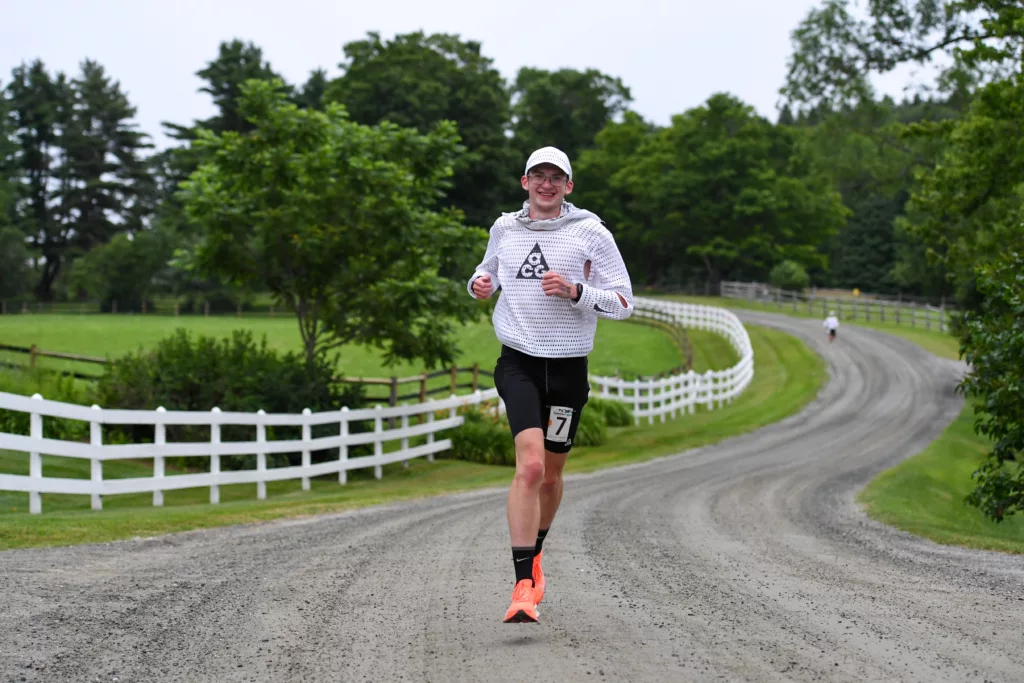
The day before the race arrived, and getting to the expo was surreal. I met with Amy the race director, who thanked me for my fundraising and gave me bib #7, because I had raised the seventh most for Vermont Adaptive. It was an honor, and I couldn’t wait to see her the next day at the finish line. Lars arrived with Davio, my personal cameraman for the race. I felt like a real pro! My parents were volunteering and I had a relaxing afternoon, mentally preparing for the goliath of a task ahead of me.
After a fine night of sleep, I woke up at 3:15am on the biggest day of my life. I threw on my Nike Radical Airflow shirt, laced up my brand new Nike Ultrafly super trail shoes, stuffed my belt with Maurten, Clif Bloks, electrolytes and water, and then sat down in the front seat of my car to write a message on my hand in sharpie: “Is this your day?” The line was inspired by John Fegyveresi, one of 20 finishers of the Barkley Marathons, the hardest race on Earth. In his podcast telling the story of his finish, John recalls getting to the final checkpoint of the race, 59 hours and 127 miles into the event. There is nobody else on the course, and John must tear a page from a book in the middle of the woods to prove he had been there. The book is titled “Is This Your Day?” and it hits John that it is his day – he is about to pull off the accomplishment of a lifetime and join a select club of the greatest ultrarunners on the planet. That moment has always stuck with me, and so I wrote it on my hand to ask myself the same question: are you going to be the one to rise above and complete the accomplishment of a lifetime?
I walked to the line, got some photos with my crew, did some easy drills, and then slotted myself in the middle of the crowd. It was a long race, and I didn’t need to be at the front in the spotlight right before the start. At 4am, we all took off, and I couldn’t stop smiling. I felt so smooth and weaved through the runners to the front of the pack. I was not going to lead until Mile 70, so I found my place in the group and just tried to fall asleep.

We hit the first mile in 7:03, and that was a bit scary. But I knew the winner was going to be in this pack, so I didn’t worry about it and let everyone else do the thinking. As the sun started to rise, a pack of six broke away, and I was right where I wanted to be. There were four guys all sharing the lead, chatting away about their prior races and goals for the day. I didn’t know who any of them were, and I tried not to think too much when they discussed their experience in ultras or sub-2:30 marathon times. I didn’t want to talk, I just wanted to relax and control the race from behind. To my right was Keith Nadeau, quietly watching the pack and never touching the front. I had seen some of Keith’s results beforehand and felt like he had a good shot to win it. More importantly, I felt like I was capable of competing with him. As the miles ticked by, I made sure to fuel with two Clif Bloks an hour (:30/:00) and a Maurten between the Bloks (:15/:45) and by Mile 16, the sun was up and the group was still together.
We ran through Taftsville where a small crowd had gathered to cheer us on. “Wow!” I thought, “I’m really in the lead pack at a 100 mile race.” Patrick Caron was there with a camera following us on the first paved road of the race and everyone started flying along the river. There was an aid station, and as I stopped to refill my water, Keith and two other guys took off up the hill. I left aid in fourth, and knew that the race was officially on. It was the longest climb of the day, three miles of gradual elevation gain. It took me two miles to catch the group, and it was not easy. We dipped into the woods and kept climbing on a rocky trail, and all my experience in the mountains was paying off because I felt awesome. However, at the crest, Keith started to push the pace and then took off on the descent. I wasn’t worried, since the whole morning there had been small moves and then the group had linked back up. But in what felt like an instant, he had 30 seconds on us.
At mile 22, we started to hear cheers and I knew we were arriving at the first crewed aid station, Pretty House. I would see my crew (my parents) for the first time all race and I was so happy… but my stomach wasn’t. I hit 2:45 in sight of the aid station so it was time for a Maurten, but it did not go down well. I saw Davio holding the camera fifty yards ahead of me and suddenly, I pulled over to the side of the road and started puking. Fortunately for me, nothing much came up and it was a nice reset for my stomach, but I did lose some time and entered the aid station in sixth. Luckily, my mom and dad were ready to put into action the lightning fast fuel swap we’d been rehearsing all week. For them, it was a brand new experience crewing for someone at the front of an ultra, but it was like they were experienced vets. I couldn’t have been there for more than 30 seconds, and took off in fifth place flying, the race spread wide apart now.

I quickly passed a runner and got myself into fourth, and hammered the next few miles with momentum from the aid station. At one point running downhill, I hit 5:50 pace! By the marathon mark, I caught a glimpse of Keith going around a corner and was surprised. He’d looked so good heading into aid, and I was shocked that two others had passed him. I wondered what could have happened. I slowly clawed my way back to him, and we went through a small aid station with two older guys ready to refill water. I didn’t get any water, but just to check I asked, “What place am I in?”
“You’re in second! Keep it up!” they yelled, and I couldn’t believe it. In all the chaos at the aid station, I lost track of two guys with their crews and assumed they had already left ahead of me. Now, I was closing hard on Keith, who still had the lead. By mile 27, I had gotten within 20 meters, but chose to not get any closer. I wanted him to know I was there, but not be able to see me. I wanted to always have an eye on him, but not have to talk or do any of the work in the lead. I looked back, and didn’t see a soul. Almost accidentally, my plan was working: it was time to control the race from second place.
We entered a more technical trail section, and I was right at home. He would run the uphills, and I would walk. He’d gain a tiny bit of ground, but I would make it right back up with almost no effort on the flats. This continued for a while, and I saw my heart rate drop below 150, after being at 180 earlier in the race. The 50K marker came and went, and I was officially on my longest run ever.
Just after 50K, we hit an aid station off the side of the road. Keith went in to refill a bottle, and I ran along a few seconds behind him. While he was off to the side in aid and I was still on the road, I technically took the lead for the first time of the race. But I didn’t care, because I knew I’d have the lead at the finish. Shortly after, we took a right turn and began a giant climb – probably 400 feet in three quarters of a mile. I hiked the entire thing while Keith ran, and while I’m sure he was working harder, he was slowly pulling away. By the top of the hill I counted a twenty second gap, and on the downhill I cranked up the pace to catch back up, just like I had done for the last seven miles.
Suddenly, while I was pushing hard on the downhill, my feet felt like they were on fire. Every step I was landing so hard in my attempt to catch him that I was slowly punishing the bottom of each foot stride by stride. Normally it wouldn’t be a problem, but I was 34 miles into the race, in unexplored territory. We got back onto dirt roads, and my legs were not happy.
On the next small climb, it was not very steep and so it wouldn’t take much effort to run. However, when we started going up, my legs would not move! I had to stop and walk, and Keith powered away. I tried running halfway up, but there was no juice. On the flats I was able to jog, but the lead was growing and there was nothing I could do. Keith rounded a corner back into the woods, and the next time I saw him was on the front page of a newspaper with his photo crossing the finish line in first.

My confidence was shattered. I could barely shuffle, and power-hiked most of the way to the next crewed aid station at Mile 38, Lincoln Covered Bridge. Somehow I had not lost second place, and the crowds went crazy when I jogged in. I knew the race for the win was over, but I still took in the moment. I was in solo second at the biggest hundred miler in New England, fairly deep into the race! Davio ran alongside me with the camera, and my parents told me I looked great. “The leader is only five minutes up on you!” said my dad, and I shook my head.
“Those five minutes came in the last four miles. I feel horrible.”
Despite my negativity, my parents reminded me to stay confident and keep trying to run. I left aid somewhat rejuvenated, and maintained a solid run up a giant climb the next mile. Still bewildered that I was in second place, I got to mile 39.5 and suddenly it was like I got hit by a train. Everything shut down, my legs could not lift more than two inches off the ground, and I could not run any further. I walked to mile 40, stopped for water, and watched a guy blow past me into second place. Knowing my race was over, I cheered him on as he powered up the hill, looking great.
Despite not being able to run, I was still on the podium and knew I had banked a ton of miles just over five hours into the race. By mile 42.8, I saw another runner coming behind me and hustled to make it to 43 before losing bronze. He flew by and I almost felt relieved: I would not be getting a spot in the top three, so all I had to worry about was finishing. Shortly after he passed me, we turned right onto a paved road and met up with the runners in the 100K (which had started at 9am), whom we would share the rest of the race with.
The next seven miles to Camp Ten Bear aid station were filled with painful walking miles where I kept falling further back in the field. When I finally saw my parents at Mile 50 I was in seventh place, and I was not in a good mood. I was halfway through the distance, but there was no telling how many more hours I would be out on the course. I ate some food, my dad encouraged me to try to run, and I limped out of aid just trying to put one foot in front of the other. I had to keep going, there was still so much time to get to the finish line.
I looked down at my hand around Mile 52. “Is this your day?” I nearly cried. No, it was not going to be my day, and it really hurt. But that was okay, someone else was going to have their day and I would be back eventually. Now, the only goal was to finish, and still check off that remarkable bucket list item of a 100 Mile completion. So many 100 Mile and 100K runners passed me and upon seeing my condition, many asked if I was okay. I thanked them for the concern and assured them that in a few days, I’d be alright. I kept marching up and down the hills, and kept my eyes set on just ticking off the miles as it started to rain. However, at Mile 56, I got to a pile of rocks and just could not get up them.
I spent more than a minute trying to will my leg up over these rocks, but nothing worked. I looked at the time and did the math – if I only managed 30 minutes per mile the rest of the way, I wouldn’t make it in time. How could I possibly go another 44 miles? Then I looked at my hand again. “Is this your day?”
I realized I’d been thinking about it all wrong. When John finished the Barkley Marathons by tearing a page from that book, he didn’t win the race. He didn’t rise above the rest, proving he was better than everyone else on the course. He finished third, but that didn’t matter at all. What mattered is that he proved that even a “regular” guy like him could do something extraordinary if he was passionate enough and willing to fight for it. I read the question again, and realized what it actually was asking:
“Is this the day that will define you?” Even though I didn’t know how I would make it, I looked at the impossible rocks sitting there on the trail and said “YES. This is my day, and I will keep moving until the clock hits 30 hours. This day will define me, because I am going to finish this race.” I took one giant step and willed myself above the next rock, and marched down the trail, determined to finish even if I had to crawl.
I finally got to Margaritaville Aid Station at Mile 59, and announced to my dad, “I cannot run, but I am still going to finish. Your goal is not to make it so I can run, but to make it so I can walk as easily as possible.” I changed out of my high-tech racing kit into comfortable hiking clothes, and ate a burger (it was so good!). Before I stepped out into the rain again Lars said to me, “Wanna know how Josh Kerr’s mile world record attempt went?” I nodded. “3:42, he got it.” Epic!
Finally I was off again, and it was just eleven miles before Lars would be joining me for the remainder of the race. As the miles continued, my feet started to become more painful, from so much pressure being put on them the whole day. I looked at my stats afterwards and on Saturday alone, I had 154,000 steps! Along the roads I was passed by Danforth Sullivan, the #1 fundraiser for Vermont Adaptive. He raised over $20,000 and a brief chat with him reminded me that I was representing something bigger than myself. I wanted to be done with the race so badly, but what a privilege it was to have the ability to suffer in a race like this. So many people wanted the chance to finish a 100 Mile Race, and I had to take advantage of mine.
After an excruciating downhill where countless more racers passed me, the rain stopped and I arrived back at Camp Ten Bear for the second time at Mile 70, completing the brutal 20 mile loop in the heart of the race. Lars was there waiting, and so were my parents and Davio. They allowed me to sit down for the first time, so I changed my socks and ate a little food. But the race wasn’t going to finish itself, so we set off and started hiking up the hill.
“This is where we were going to make the move,” I said to Lars. “We were going to blow by the leader and take this race by the throat.” Unfortunately, we did not have such a glamorous climb, but it was so refreshing to chat with someone and time flew on the way to Spirit of 76 aid station. The sun was starting to set, and for the first time, I could sense the finish approaching.
Spirit of 76 was my favorite aid station. First off, I felt like we did a great job taking care of my foot problems and the food tasted awesome. But more importantly, Jackson, Xavier, and Colby from Exeter High School were there as volunteers, and it was awesome to see them cheering for me! It reminded me that the entirety of NHXCTF was behind me, and boy did I get fired up. I got some bug spray from Jackson and as I shuffled out of the station I said “see you tomorrow boys!” as in less than 24 hours, I’d somehow be working as a counselor at Stowe Running Camp, and they’d be attending.
The next 12 mile stretch between crewed aid stations was the longest and hardest of the race. I couldn’t fathom how I’d just ticked off miles in the early parts of the day, because now I was struggling to hit each split in 20 minutes, even on the flat dirt roads. I felt phenomenal coming out of Mile 76, but then at Mile 78 Lars asked me, “Do you think you can try to run?” I figured I might as well give it a shot, but as soon as I took one stride everything started to hurt more than it had the entire day. It was the biggest mistake of the race, and things only got worse the rest of the way home. I had to stop at least once a mile to bend over and give my feet a break, and it was completely pitch black out.
At Mile 82, the route got within a quarter mile of the finish, before turning south for the final loop of the race. I knew if I’d hit my goals I would have already been done, and that was torture. But there was no time to dwell on what could have happened, and at Mile 83 my spirits were lifted by a cow-themed aid station! Everyone was wearing a cow onesie and they were so enthusiastic, even at 11pm. I smiled the whole time and Lars got a photo so I could remember it. We soldiered on to Bill’s aid station at Mile 88, and I remember feeling particularly strong on the uphills, probably since it put the least pressure on my feet. Finally, we got to Bill’s and I was so happy to get to sit again!
I cruised out of Bill’s after a ten minute break and was ready to motor to the finish. Lars rolled his ankle on a root and for a second, I was proud that I looked a tiny bit better than him. It was “only” six miles to the final aid station, Polly’s. The calendar had switched to Sunday, and instead of being passed by my competitors, I was finally going the same speed as them. Somewhere along the way, I did the math and realized I could break 24 hours if I really got moving, but I didn’t care. I would have many more chances to smash 24 hours, and this race was all about getting to the end. The climbs were alright and the downhills were brutal, but I kept putting one foot in front of the other and got to Polly’s just after 2am.
I remember the feeling of walking into the aid station and reflecting on all the years my dad has spent obsessed with this race, in shock that I had actually made it. He has so many stories about his friends at Polly’s, suffering and giving everything they have to reach the line. He was there himself when he finished the 100K. Now, his son was experiencing the same place in the same situation, and I was so proud that I got to bring him there again to be a part of my team. I remember eating some bacon, absolutely loving it, and then wasting no time getting out of there because I was ready to be done. We marched off and my parents yelled, “See you at the finish!”

I was on a mission. I powered away with the end in sight, and the next three miles flew by. But then, at Mile 97.5, everything shut down, worse than ever. At three in the morning I hallucinated and saw a bike on the trail, and just wanted to sit down on it for some reason. A few minutes later I told Lars I needed thirty seconds to close my eyes, and so I laid on the trail, a mere 4000 meters from the finish. I couldn’t help laughing because I was so insanely close and knew it would be fine. There were seven hours to spare so there was no doubt I would make it, but I’d put my body through so much and finding the strength to complete the home stretch took everything I had. Finally, I got up and never stopped the rest of the way. We hit 98 miles and I felt alive again.
I’m sure it didn’t look like it, but it felt like we flew up the final hill in Mile 99. My stride was powerful and determined, and the moment started to feel like reality. I thought of my family, my friends, and reflected on the impact finishing this race could have on all the people who look up to me. I won’t pretend like I don’t know how many current high schoolers are influenced by what I do – whether that’s commentating all the races for NHXCTF, or the runners at Coe-Brown’s summer camp who asked me so many awesome questions about preparing for the 100 mile race when I came as a guest speaker. I thought of the campers at Stowe I would see in eight hours, and how proud they would be to hear that I finished. I figured if I could somehow get even one kid interested in ultras one day, then the suffering would all be worth it. I hit the “One Mile To Go” sign and all the pain disappeared.

With 800 meters left, Lars took off to let everyone at the finish know I was coming in. I started to close the gap on a runner in front of me, but I eased off the gas a little so he could have his moment and I could have mine. Hundreds of lanterns began to illuminate the trail, and I could hear cheers through the trees as the destination approached. At long last, I rounded the bend and at 4:32am, more than a day after the journey began, I crossed the finish line of the Vermont 100 Miler. I saw my family, Amy the race director gave me a big hug, and as I sat down I was handed my silver finisher’s belt buckle.
During the hardest parts of the race, I expected to cry at the line, or at bare minimum collapse in exhaustion and shock. But to my surprise, when I was sitting there, I wasn’t feeling emotional… I was feeling hungry. I just smiled and thought to myself, “I can’t wait to come back, get this right, and win this race someday.” I was so proud of what I’d done, but I knew right away that my story wasn’t finished, and there wasn’t a single doubt in my mind that I would return stronger, more prepared, and ready to battle again. It was the most fun day of my life, and I couldn’t wait for my next opportunity.
I also couldn’t wait to sleep. After a few celebratory photos, I wrapped my arms over my parent’s shoulders and they carried me to my car. I crawled in the back, got a lovely ninety minutes of sleep, and then immediately drove off to summer camp where I was put through the wringer again for a full week of terrible recovery. It was awesome.

It’s been a few weeks since the race now, and I’m so glad I found a way to reach the finish. I noted this on my Instagram, but I am so incredibly lucky that I can feel disappointed with completing a 100 Mile Race. How cool is it that I have the opportunity to set the bar so high for myself, and get to compete in a sport where even if you don’t accomplish your goal, reaching the line is celebrated as the achievement of a lifetime, not a failure? I have nothing but gratitude for ultrarunning and all the places and people it has made a part of my life. Thanks to everyone for being a part of this journey and giving me a platform to share my adventures with the world, I will never take it for granted! I’m so excited to see what’s next.